The preservation of lithographs stands as one of the most delicate challenges facing collectors and custodians of visual art today. These works, produced through an intricate process involving greasy ink and limestone or metal plates, demand meticulous care to ensure they endure for future generations. Among the various threats to their longevity, fluctuations in environmental conditions pose perhaps the greatest risk, with atmospheric moisture levels emerging as a decisive factor in either safeguarding or hastening the decline of these treasured prints.
- Lithographs are highly sensitive to environmental moisture because paper is hygroscopic, causing it to expand or contract based on atmospheric humidity levels.
- Excessive humidity promotes mould growth and mineral crystallisation in porous limestone, while dry air leads to brittleness and cracking in paper substrates.
- Conservation experts recommend maintaining a stable relative humidity between thirty and fifty per cent to ensure the long-term preservation of lithographic prints.
- Rapid fluctuations in humidity are as damaging as extreme levels, necessitating the use of sophisticated climate control systems to protect paper fibres and adhesive bonds.
- Cleaning delicate nineteenth-century lithographs requires specialized, restrained techniques, prioritizing dry methods to avoid activating acidic compounds or causing ink damage.
- Deacidification treatments are essential to neutralize harmful acids that cause paper yellowing and disintegration, provided they are applied without compromising pigment integrity.
- Historical adhesives are prone to failure over time, requiring the use of modern, conservation-grade alternatives to ensure the structural stability of the artworks.
The fundamental science behind humidity control in lithograph conservation
How moisture affects paper-based lithographs and limestone printing surfaces
At the heart of lithographic preservation lies an understanding of how water vapour interacts with the materials that comprise these artworks. Paper, the most common substrate for lithographs, is inherently hygroscopic, meaning it readily absorbs and releases moisture from the surrounding atmosphere. When relative humidity climbs excessively, fibres within the paper expand, creating conditions ripe for dimensional distortion and the proliferation of mould. Conversely, when the air becomes too dry, paper contracts and grows brittle, rendering it vulnerable to cracking and irreversible damage. This constant dance between expansion and contraction accelerates deterioration, particularly in works created during the nineteenth century, when paper manufacturing standards varied considerably and acid content in pulp was often high.
The limestone surfaces traditionally used in lithographic printing face similarly complex challenges. Though the stone itself may appear robust, it remains porous and susceptible to moisture infiltration. Elevated humidity can encourage mineral salts within the limestone to migrate and crystallise, potentially disrupting any remaining ink or causing surface degradation. For institutions housing both the finished prints and the original stones, maintaining stable atmospheric conditions becomes doubly critical. The adhesive materials used historically to mount or repair lithographs also react sensitively to moisture, with many traditional formulations losing their integrity or becoming overly tacky when exposed to high humidity levels.
Optimal relative humidity levels for long-term lithograph preservation
Achieving the correct balance in humidity control requires precision and consistency. Conservation professionals widely recommend maintaining relative humidity within the range of thirty to fifty per cent for paper-based artworks, a zone that minimises both the risks of mould growth and the brittleness associated with excessively dry conditions. This guidance reflects decades of empirical research and observation within museums and galleries, where even minor deviations from these parameters have been shown to trigger swift and sometimes catastrophic deterioration.
Stability matters as much as the absolute value. Rapid fluctuations in humidity, even within the recommended range, can cause repeated cycles of expansion and contraction that weaken paper fibres and stress adhesive bonds. For this reason, institutions often invest in sophisticated climate control systems that maintain not only appropriate humidity levels but also shield collections from seasonal variations and sudden environmental shifts. Desiccant dehumidification systems have proven particularly effective in creating stable microclimates, as they can respond dynamically to changes in atmospheric moisture and provide precise control even in challenging conditions.
Essential preservation techniques: from cleaning to deacidification methods
Professional cleaning approaches for 19th-century lithographs including toulouse-lautrec works
The cleaning of lithographs, particularly those dating from the height of the medium's popularity in the nineteenth century, demands specialised knowledge and a restrained touch. Works by artists such as Toulouse-Lautrec, renowned for his vibrant colour lithographs depicting Parisian life, present unique challenges due to the delicate nature of the inks and the often fragile condition of the paper after more than a century of exposure. Professional conservators approach such pieces with techniques designed to remove surface grime and accumulated pollutants without disturbing the original pigments or the paper structure beneath.
Dry cleaning methods, employing soft brushes and specialised erasers, often serve as the first line of intervention. These techniques lift surface dirt without introducing moisture, which could activate latent acidic compounds or cause inks to bleed. When aqueous cleaning becomes necessary, conservators use carefully controlled solutions and minimal contact, sometimes working through interleaving tissues to diffuse the cleaning action. The decision to proceed with any wet treatment depends on thorough analysis of the paper's condition, the stability of the inks, and the presence of any previous restoration attempts that might complicate the process.
Modern deacidification treatments and conservation-grade adhesive applications
Acidic deterioration represents one of the most insidious threats to paper-based lithographs. Over time, acids naturally present in paper or introduced through atmospheric pollutants cause fibres to break down, leading to yellowing, embrittlement, and eventual disintegration. Deacidification treatments have been developed to counteract this process by neutralising existing acids and depositing an alkaline reserve that buffers against future acidification. These treatments, typically involving alkaline solutions or vapour-phase applications, must be executed with precision to avoid altering the appearance of the artwork or compromising the integrity of the inks.
Equally important is the use of conservation-grade adhesives when repairs or mounting become necessary. Historical adhesives, often derived from animal proteins or starches, can fail over time or react adversely to changes in humidity. Contemporary conservation practice favours reversible adhesives that provide secure attachment without penetrating deeply into paper fibres or leaving residues that could darken or stiffen the substrate. These modern formulations allow future conservators to reverse interventions if better techniques emerge or if the adhesive begins to degrade, ensuring that preservation efforts do not inadvertently trap the artwork in an irreversible state.
Proper Framing and Environmental Management for Lithograph Longevity
Contemporary support materials and temperature-controlled display solutions
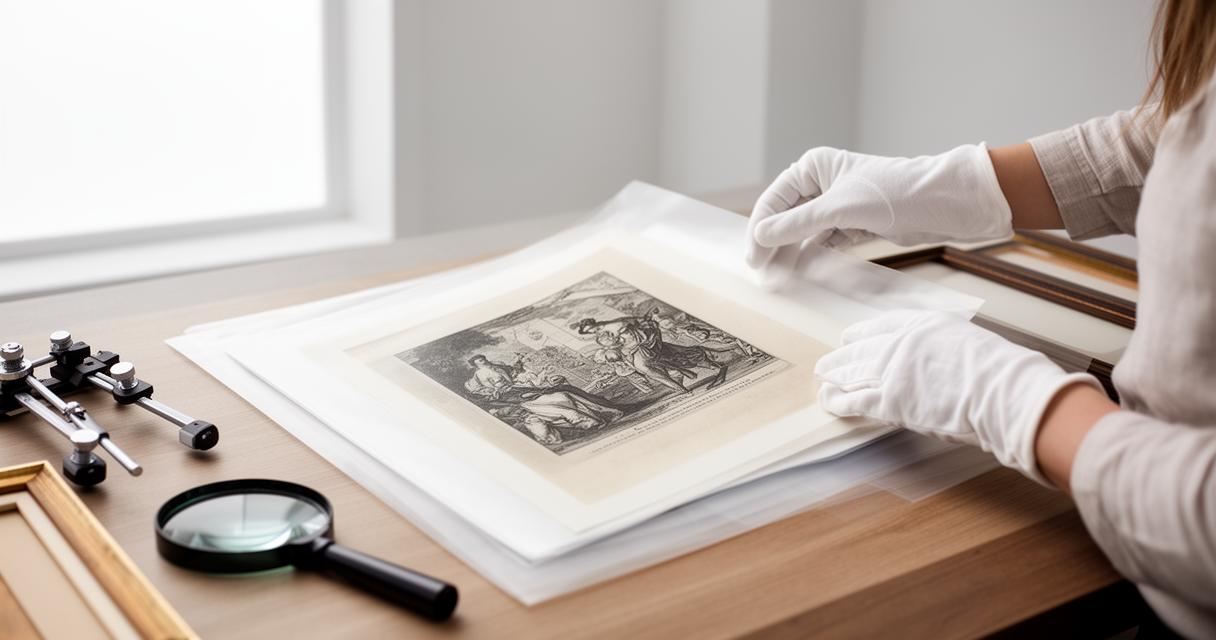
The materials chosen to support and display lithographs play a crucial role in their long-term survival. Archival-quality mat boards, free from lignin and buffered with alkaline compounds, create a protective barrier between the artwork and potentially harmful external elements. When spacing works for storage, thick mat board prevents physical contact between prints, reducing the risk of ink transfer or surface abrasion. For framed pieces, the use of acid-free mounting techniques ensures that the lithograph remains secure without introducing chemical threats.
Temperature control complements humidity management in creating ideal preservation conditions. While the focus often falls on moisture levels, temperature fluctuations can exacerbate the effects of humidity changes and accelerate chemical degradation. Maintaining a stable temperature around eighteen to twenty degrees Celsius, combined with consistent relative humidity near fifty-five per cent, creates an environment where paper remains dimensionally stable and chemical reactions proceed at the slowest possible rate. Climate-controlled display cabinets offer an effective solution for particularly vulnerable pieces, allowing them to be exhibited whilst remaining protected within a carefully regulated microenvironment.
Light exposure mitigation strategies and archival framing best practices
Light, whilst essential for viewing and appreciating lithographs, poses a significant conservation challenge. Both natural and artificial light sources emit ultraviolet radiation that causes inks and paper to fade, yellow, and weaken over time. Conservation framing incorporates glazing materials that filter out harmful wavelengths whilst maintaining visual clarity. Museum-quality acrylic or specially treated glass can block up to ninety-nine per cent of ultraviolet light, dramatically slowing the photochemical degradation of the artwork beneath.
Beyond material selection, thoughtful placement and controlled exposure times further extend the life of displayed lithographs. Rotating works on display allows pieces to rest in storage, reducing cumulative light exposure. When storage becomes necessary, wrapping unframed lithographs in acid-free tissue and placing them in archival boxes shields them from light, dust, and physical damage. For rolled works, gentle storage in sturdy tubes prevents creasing whilst avoiding the stress that tight rolling can impose on brittle paper. Each of these practices, when combined with rigorous humidity and temperature control, forms a comprehensive preservation strategy that honours the artistic and historical value of lithographic prints whilst ensuring their survival for generations yet to come.